How Much Audio Do You Need to Clone a Voice?
Curious about AI voice cloning? This guide breaks down the audio requirements, explaining what you need to create a digital replica of a voice.
10 min read · September 4, 2026
Content creators, podcasters, audiobook narrators, and anyone interested in using AI for voice generation often face a common question: how much audio do you actually need to clone a voice? The answer can feel elusive, with some sources suggesting hours of recordings while others hint that a few minutes might suffice. This uncertainty can be a barrier to entry, making the prospect of AI voice cloning seem more daunting and resource-intensive than it needs to be.
This article cuts through the confusion. We’ll explore the practical requirements for AI voice cloning, focusing on the critical factor of audio quality and setting realistic expectations for the amount of data you’ll need. You'll learn that less audio can often be sufficient than many believe, and that the characteristics of your source material are paramount. We'll also touch upon the ethical considerations and introduce you to accessible tools that can help you achieve your voice generation goals.
Understanding AI Voice Cloning
AI voice cloning, also known as voice synthesis or voice replication, is a technology that allows computers to generate speech that sounds remarkably like a specific human voice. It works by analyzing a sample of a person's speech and then using artificial intelligence models to create new audio content in that same voice. This process typically involves deep learning algorithms that identify and learn the unique characteristics of a voice, such as pitch, tone, accent, and cadence.
The applications for AI voice cloning are vast and growing. For content creators, it can be a powerful tool for producing consistent audio across multiple projects, creating personalized audio messages, or even generating voiceovers for explainer videos and marketing materials. Podcasters might use it to create consistent intros and outros, or to re-record segments without needing the original speaker present. Audiobook narrators could leverage it for specific character voices or to maintain consistency across long projects. It's also finding use in accessibility tools, virtual assistants, and even for bringing historical figures to life.
As the technology matures, it's becoming increasingly accessible. What once required specialized hardware and deep technical expertise is now within reach for many creators. Tools like AI Voice Cloning are simplifying the process, allowing users to experiment and produce high-quality results with less effort. The ability to generate custom voices opens up new avenues for creative expression and efficient content production, making it an exciting area for anyone involved in audio and video creation. Whether you're looking to enhance your existing content or explore entirely new forms of AI voice generation, understanding the fundamentals of voice cloning is key. This technology can also be a boon for podcast narration, offering flexibility and consistency.
The Crucial Factor: Audio Quality Over Quantity
When it comes to AI voice cloning, the common misconception is that more audio data is always better. While having a larger dataset can certainly contribute to a more nuanced and accurate clone, the quality of the source audio is far more important than the sheer volume. Think of it like trying to learn a language. Hearing someone speak for hours with a heavy accent, mumbling, or in a noisy environment won't teach you the language as effectively as listening to clear, well-articulated speech for a shorter period.
What constitutes 'good quality' audio for cloning? It's audio that is clean, clear, and consistent. This means:
- Clarity: The speech should be easy to understand, with no mumbling or slurring.
- Lack of Background Noise: Excessive background noise, such as traffic, air conditioning hum, or other people talking, can interfere with the AI's ability to isolate and learn the target voice.
- Consistent Tone and Delivery: The speaker should ideally maintain a relatively consistent tone, pace, and emotional delivery throughout the recording. Sudden shifts in volume, extreme emotional outbursts, or drastically different speaking styles can make it harder for the AI to create a cohesive cloned voice.
- Single Speaker: The audio should feature only the voice you intend to clone. Music, overlapping speech, or multiple speakers will confuse the AI.
If you have 10 minutes of crystal-clear audio recorded in a quiet studio, it will likely yield better results for voice cloning than an hour of audio recorded in a busy coffee shop with a lot of ambient noise. The AI needs a clean signal to accurately capture the unique phonetic and prosodic characteristics of the voice.
How Much Audio is 'Enough'?
So, to get to the heart of the matter, how much audio is truly ‘enough’ to clone a voice effectively? The answer depends on your goals and the desired level of accuracy.
For basic voice cloning - where you might need a voice that sounds similar to the target for less critical applications, like a simple disclaimer or a placeholder voice - you might get away with as little as 1 to 2 minutes of clean audio. This could be enough for the AI to capture the fundamental pitch and general tone. However, the resulting voice might sound a bit robotic, lack natural intonation, or have occasional artifacts.
For highly accurate and nuanced cloning - where you want the cloned voice to be virtually indistinguishable from the original, capable of expressing a range of emotions and subtle inflections for professional use like audiobook narration or character acting - you’ll generally need more. This could range from 5 to 15 minutes of high-quality audio. This extended duration allows the AI model to learn more about the speaker's vocal nuances, common speech patterns, and emotional range.
It's important to reiterate that even short clips can be sufficient for some applications. If you're looking to create a voice for a short automated message, a notification sound, or a simple chatbot response, a very brief, clear recording might be all you need to get a recognizable likeness. The key is that the shorter the audio sample, the more critical its quality becomes.
Many modern AI voice cloning tools are designed to be efficient. They use sophisticated algorithms that can extract a significant amount of information from relatively small, high-quality audio samples. This means that the daunting prospect of needing hours of audio is often a myth perpetuated by older or less advanced technologies.
What Makes for Great Source Audio?
To maximize your chances of a successful voice clone, even with limited audio, focus on creating the ideal source material. Here are the characteristics of audio that AI systems thrive on:
- Clear Speech: The speaker should enunciate clearly. Avoid mumbling, trailing off at the end of sentences, or speaking too quickly. Each word should be distinct.
- Consistent Speaking Style: While a range of emotions is good for highly accurate cloning, try to maintain a relatively consistent pace, volume, and tone throughout the recording session. If you need to capture different emotional states, it's often better to record separate samples for each.
- Minimal Background Noise: This is paramount. Record in the quietest environment possible. Turn off fans, air conditioning units, and close windows. Inform others in the vicinity that you are recording. Even subtle hums can be problematic.
- No Music or Overlapping Speech: The audio should be exclusively the target voice. Music beds, sound effects, or any other audio elements will interfere with the AI's processing. Similarly, avoid any instances where multiple people are speaking at once.
- A Single Speaker: Ensure that only the voice you intend to clone is present in the recording. This prevents the AI from trying to learn multiple vocal characteristics simultaneously.
- Natural Intonation and Cadence: While consistency is important, the audio should still sound natural. Avoid a monotone delivery if possible, as the AI needs to learn the natural rhythm and flow of the speaker's voice.
- Good Microphone Quality: Using a decent quality microphone will capture your voice more accurately and with less unwanted noise than a built-in laptop microphone or a low-end headset.
By paying attention to these details, you create a clean, focused dataset that allows the AI to learn the essential qualities of the voice with greater precision.
Ethical Considerations in Voice Cloning
As AI voice cloning technology becomes more powerful and accessible, it's crucial to address the ethical implications. The ability to replicate someone's voice raises significant concerns about misuse, such as creating deepfakes, spreading misinformation, or impersonating individuals without their consent.
Therefore, the most important ethical guideline for using AI voice cloning technology is consent. You should only clone voices for which you have explicit permission from the original speaker. This applies whether you are cloning your own voice, a colleague's, a friend's, or a celebrity's. Unauthorized voice cloning can have serious legal and reputational consequences.
Always ensure you understand and adhere to the terms of service of any AI voice cloning tool you use, and prioritize responsible application of the technology. Using voice cloning to enhance creative projects or improve accessibility is one thing; using it for deception or malice is entirely another.
Using Textalky for Voice Cloning
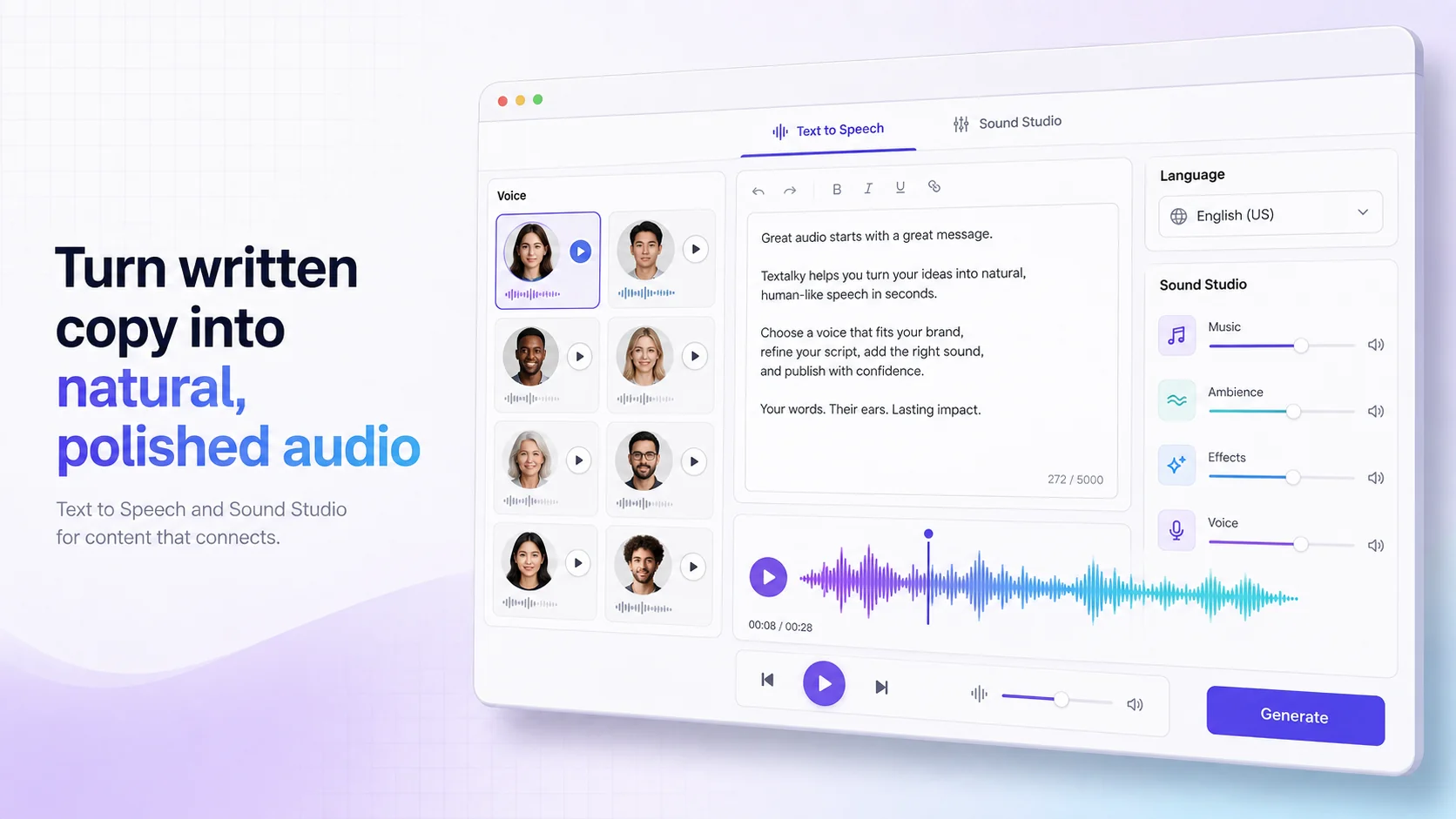
Navigating the world of AI tools can be overwhelming, especially when you need multiple functionalities. Textalky offers an integrated solution, acting as your complete AI creative studio. Within this all-in-one platform, you'll find a powerful AI Voice Cloning feature designed to simplify the process for creators.
With Textalky, you don't need to piece together different services or worry about complex integrations. The voice cloning tool is designed for ease of use, allowing you to upload your source audio directly within the platform. You can then expect the AI to process this audio and generate a synthetic version of the voice. The platform aims to provide a streamlined experience, so you can focus on your creative output rather than the technical hurdles.
While Textalky provides the tools, remember that the quality of your input audio remains key. For those looking to dive deeper, Textalky also offers resources like a detailed step-by-step guide to help you get the most out of the voice cloning feature.
For users looking for the most comprehensive and cost-effective way to access all of Textalky's AI capabilities, including voice cloning, the AI Lifetime Pro deal is currently featured. This one-time purchase offers lifetime access to the studio, which includes every tool, making it a compelling option for serious creators. You can explore the current terms and details of the AI Lifetime Pro deal to see if it aligns with your needs. If you prefer a subscription model, you can also compare the various Textalky plans to find the best fit for your workflow.
Beyond Cloning: Other AI Voice Tools
Textalky’s commitment to being an all-in-one creative studio extends beyond just voice cloning. The platform offers a rich suite of AI-powered audio tools designed to cover a wide range of content creation needs.
For instance, if you need to generate new voiceovers from text, the AI Voiceover tool is invaluable. You can input your script and select from a variety of high-quality, studio-grade voices to create professional-sounding narration for videos, presentations, or advertisements. This is a fantastic way to add a polished audio layer to your content without hiring voice actors.
On the other side of the spectrum, if you have existing audio recordings - perhaps lectures, interviews, or meeting minutes - that you need to convert into text, the AI Transcribe feature is your solution. This tool can accurately convert speech into written text, saving you hours of manual transcription work. It’s a vital tool for researchers, journalists, and anyone who needs to process spoken content into a readable format.
These tools, alongside AI Voice Cloning, are integrated into a single interface, providing a cohesive and efficient environment for all your audio production needs.
Frequently Asked Questions
How much audio is needed to clone a voice?
For basic voice cloning, as little as 1 to 2 minutes of clean, clear audio might suffice. For highly accurate and nuanced cloning suitable for professional use, 5 to 15 minutes of high-quality audio is generally recommended.
Is it better to have more audio or higher quality audio for voice cloning?
Higher quality audio is significantly more important than the sheer quantity of audio. Clean, clear speech with minimal background noise and consistent delivery will yield better results than a much longer recording that is noisy or inconsistent.
Can I clone my voice with just a few minutes of audio?
Yes, for many applications, a few minutes of high-quality audio can be sufficient to clone a voice recognizably. The resulting clone might be less nuanced than one made with more data, but it can be perfectly adequate for less critical uses.
What are the ethical considerations for AI voice cloning?
The primary ethical consideration is consent. You must have explicit permission from the voice owner before cloning their voice. Unauthorized cloning can lead to misuse, misinformation, and legal issues. Always use voice cloning technology responsibly and ethically.
Conclusion
The requirements for AI voice cloning are often less demanding than many anticipate. While the pursuit of perfect replication might benefit from extensive audio data, the cornerstone of successful voice cloning lies in the quality of your source material. Clear, consistent, and noise-free audio, even in short durations, can be enough to achieve impressive results. By focusing on these critical factors, you can demystify the process and harness the power of AI voice generation effectively.
For creators looking for a comprehensive and accessible solution, Textalky offers an all-in-one AI creative studio that integrates voice cloning, voiceovers, transcription, and much more. If you're ready to explore the possibilities and want to access these powerful tools with exceptional value, consider comparing the different Textalky plans. For a particularly compelling offer, the AI Lifetime Pro deal provides lifetime access to the full suite of tools for a one-time payment. It's a great opportunity to equip yourself with a complete AI creative toolkit.
Ready to try it yourself?
Create a free Textalky account - no credit card required - and put this into practice.
Start creating for free